
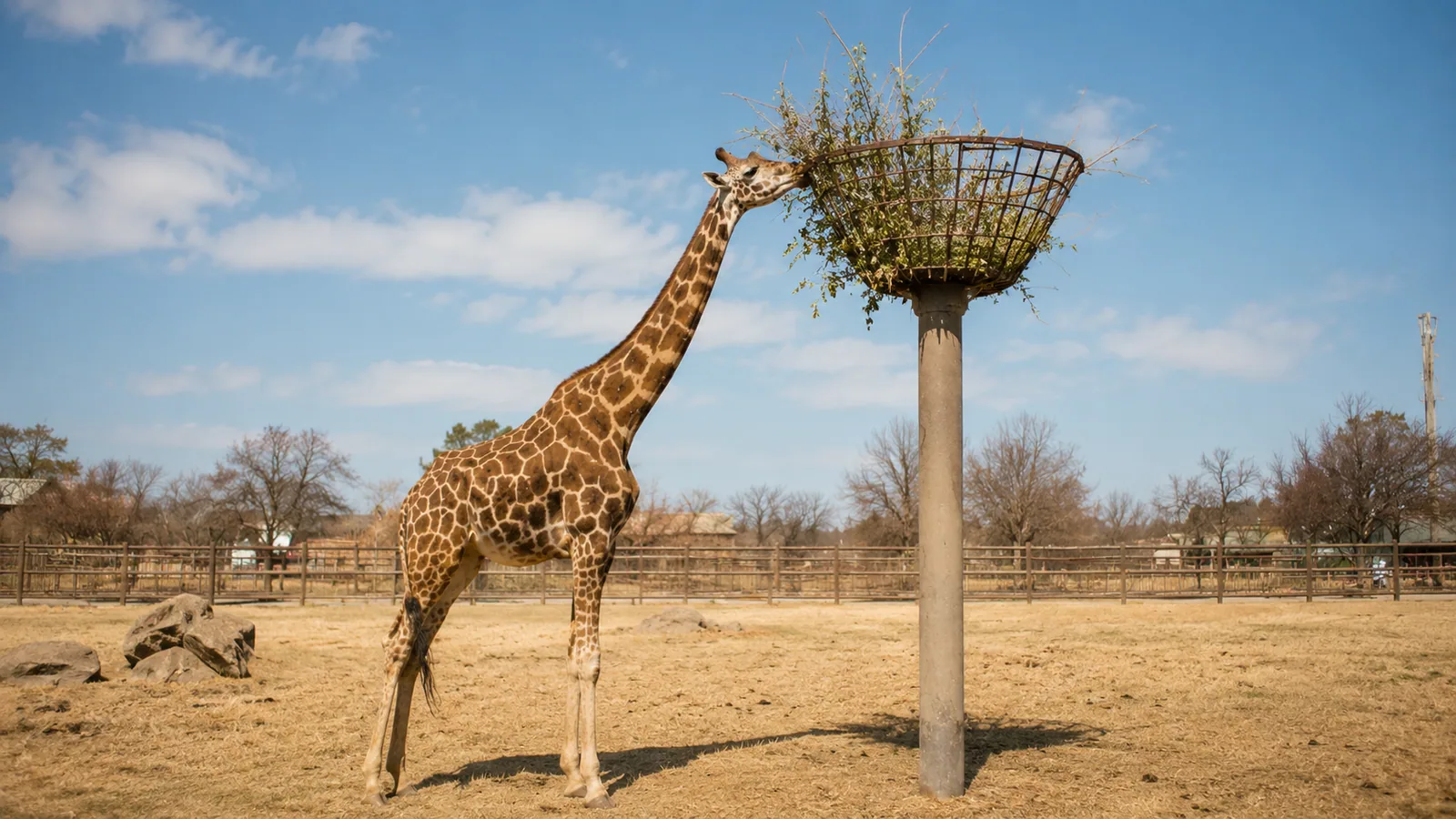
Zoo animals are not just being cute. Learn how zoo animal enrichment keeps them active, curious, and engaged during every zoo visit.
~2,365 words11 sectionsJun 10, 2026When Zoo Animals Play, There May Be More Going on Than You Think
Some of the best zoo moments happen when you least expect them.
A polar bear splashes into the water. A sea lion darts through the pool with a toy. An Arctic fox pounces, pauses, and then takes off again. A bird sits proudly in the sunshine, almost as if it knows everyone is watching.
Those moments make us smile because they are fun, surprising, and sometimes downright hilarious. But many of these behaviors may also give visitors a glimpse into something very important in modern zoo care: animal enrichment.
Zoo animal enrichment is one of those behind-the-scenes topics that can completely change the way you watch animals at the zoo. Once you know what to look for, a simple zoo visit becomes more than walking from exhibit to exhibit. It becomes a chance to notice behavior, curiosity, problem-solving, and the thoughtful care that helps animals stay active and engaged.
At Zoos4You, we love those little moments. We enjoy watching animals play, rest, explore, interact, and surprise us. But we also love learning why those moments matter. Animal play is not always “just play.” Sometimes it is exercise. Sometimes it is problem-solving. Sometimes it is instinct. Sometimes it is a keeper-created activity designed to encourage natural behaviors in a safe and healthy way.
So the next time you see a zoo animal splashing, sniffing, climbing, digging, or rolling around with a toy, pause for a moment. You might be seeing the fun side of science.
What Is Zoo Animal Enrichment?
Animal enrichment at the zoo means giving animals safe and meaningful ways to use their bodies, minds, senses, and natural instincts.
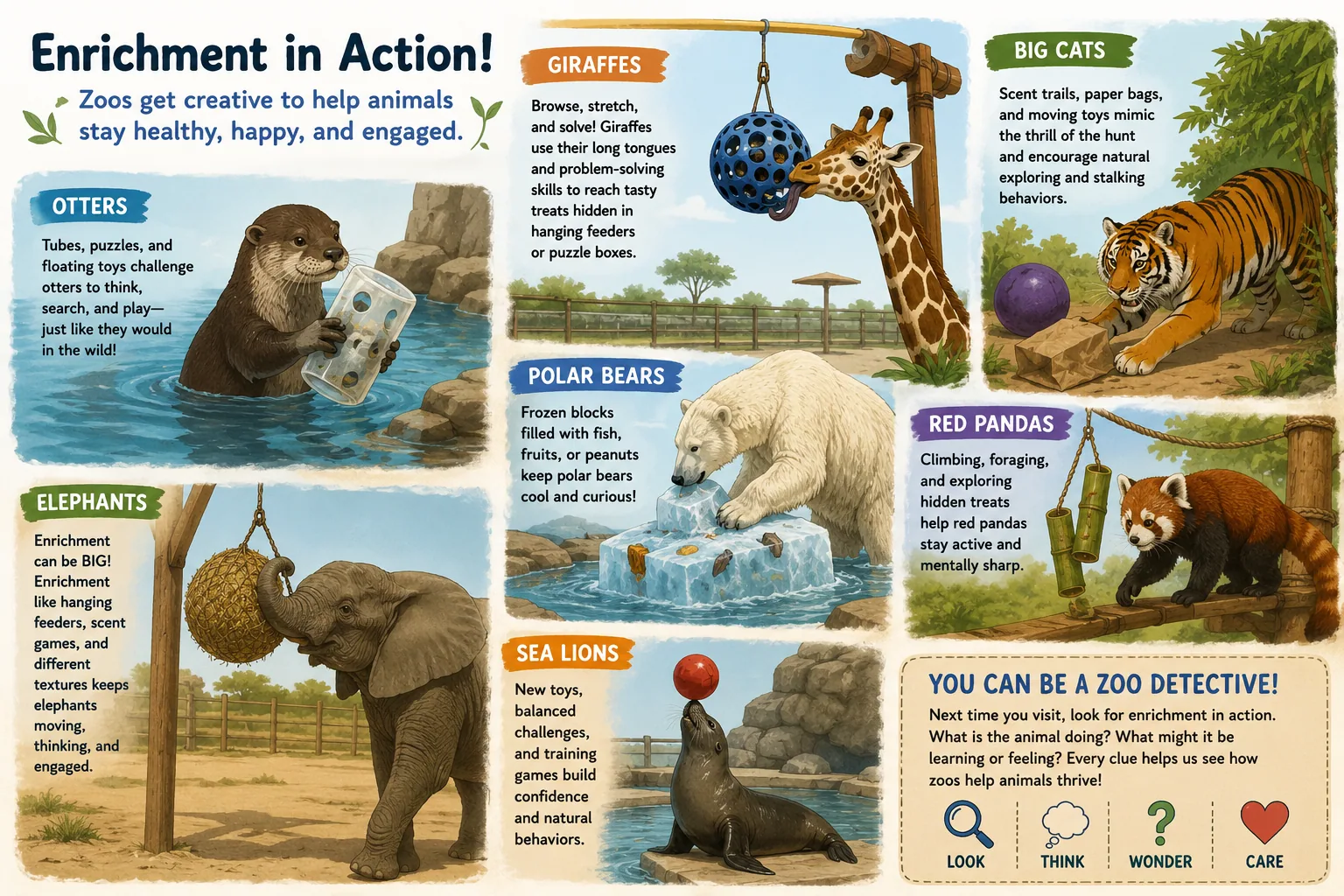
That can look different depending on the animal. A polar bear may interact with water, ice, scents, or floating objects. A big cat may investigate a scent trail. A primate may work through a puzzle feeder. A bird may search for food in a hanging feeder. An elephant may explore a habitat feature or forage for hidden food.
The goal is not just to keep animals “busy.” The goal is to support animal well-being by encouraging behaviors that matter for that species.
In the wild, animals spend much of their time searching, climbing, swimming, digging, smelling, listening, watching, hunting, foraging, building social connections, or solving problems. In a zoo setting, keepers and animal care teams create enrichment opportunities that encourage some of those same instincts.
That is why enrichment may include:
Food puzzles Scent trails Floating toys Boxes, balls, barrels, or logs Climbing structures Training sessions Foraging activities Water play Ice treats Habitat changes Objects to investigate Sounds, textures, or smells
The fun part for families is that enrichment often looks playful. The educational part is learning that play can have a purpose.
Why Do Zoo Animals Play?
When people ask, “Why do zoo animals play?” the answer is not always simple. Animals may play, explore, investigate, chase, wrestle, swim, or interact with objects for many reasons.
Some play helps young animals practice skills they may need as adults. Some play encourages movement and exercise. Some behavior is tied to curiosity. Some animals explore new objects because they are using their senses. Some social animals interact with each other in ways that help build relationships or establish boundaries.
And sometimes, an animal may simply be responding to something interesting in its environment.
For visitors, these moments are wonderful because they make animals feel more relatable. We recognize curiosity. We recognize play. We recognize the joy of discovery. But it is important to remember that animals are not little people in fur, feathers, or scales. Their behavior has its own meaning.
That is what makes watching zoo animals so interesting. A child may see a sea lion chasing a toy and say, “It is playing!” An adult may look closer and realize the sea lion is also swimming, turning, diving, problem-solving, and using its body in powerful ways.
Both observations can be true.
That is the magic of zoo education. The cute moment opens the door. The science helps us understand what we are seeing.
Examples of Animal Enrichment Families Might Notice
Once you know what enrichment can look like, you may start spotting it all over the zoo.
Food Enrichment
Food enrichment encourages animals to work for food in a way that feels more natural than simply eating from a bowl.
This might include food hidden inside logs, placed in puzzle feeders, scattered around a habitat, tucked into hay, frozen into ice, or hung from branches. Foraging activities can encourage animals to sniff, search, reach, climb, dig, or problem-solve.
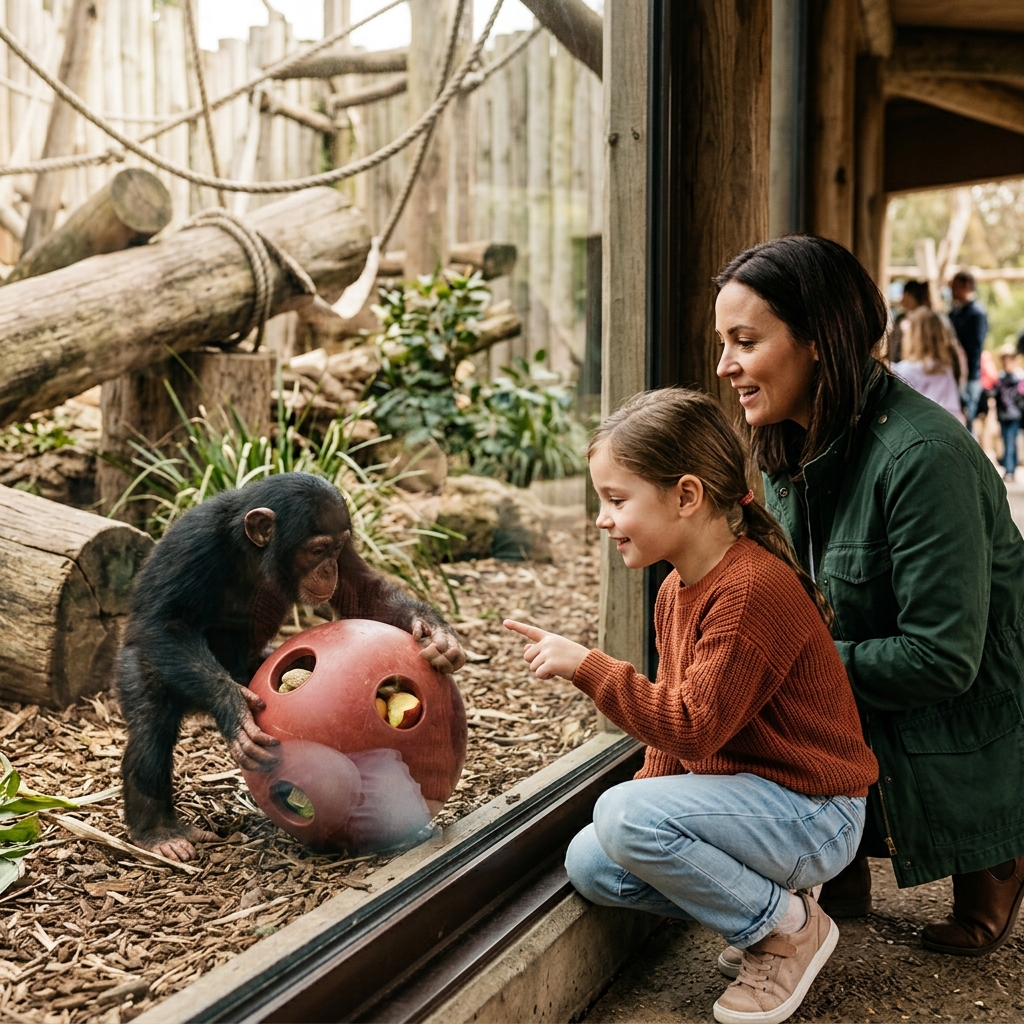
A meerkat searching for food, a bird working at a feeder, or a primate figuring out a food puzzle may all be using natural behaviors.
Scent Enrichment
Many animals experience the world strongly through smell. Scent enrichment may include herbs, spices, animal-safe scents, or natural materials placed in a habitat.
Big cats may pause to investigate a scent trail. Foxes may sniff and explore a new smell. Bears may rub, roll, or investigate something new in their space.
To visitors, this may look simple. To the animal, it can be a full sensory experience.
Object Enrichment
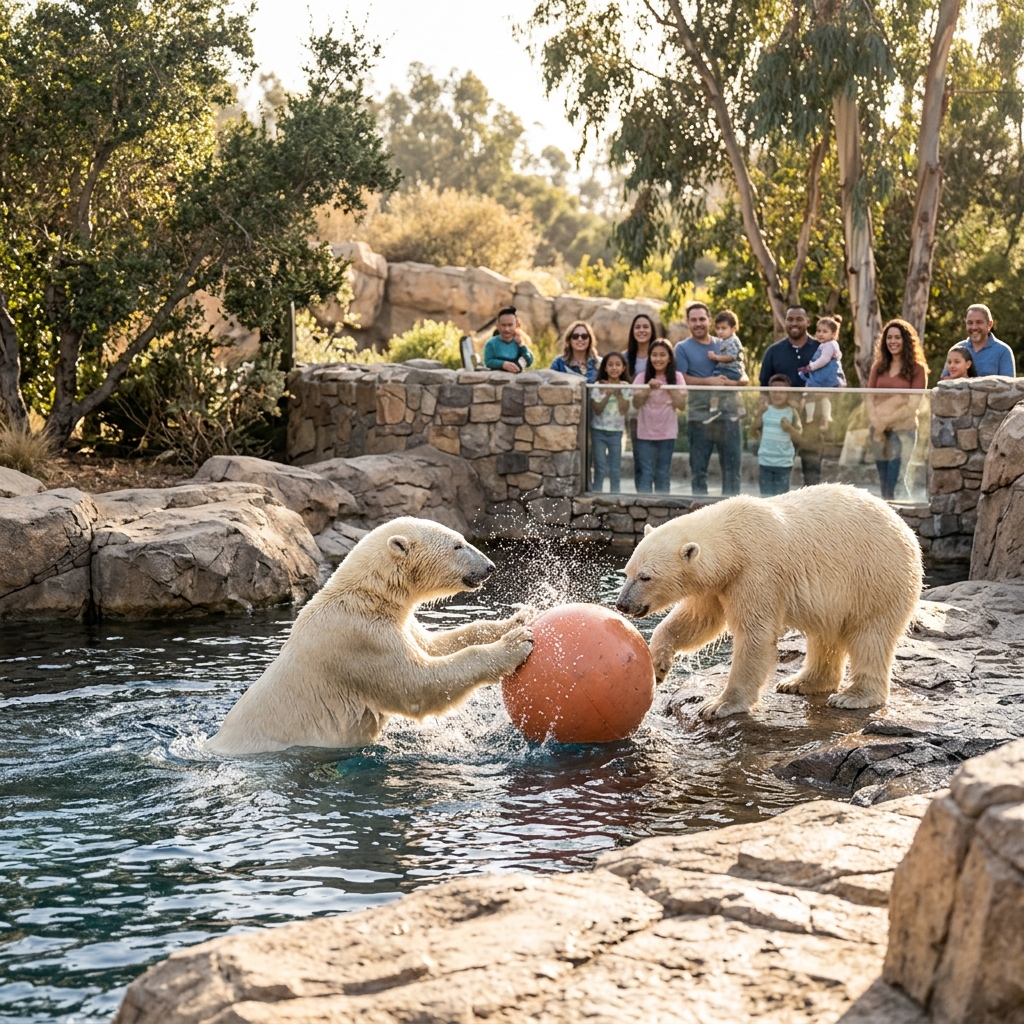
Objects can encourage play, exploration, strength, coordination, and problem-solving. These may include balls, barrels, boxes, logs, ropes, floating toys, or durable objects designed for animal use.
A polar bear pushing a floating toy through the water is not only fun to watch. It may also encourage swimming, paw use, strength, curiosity, and problem-solving.
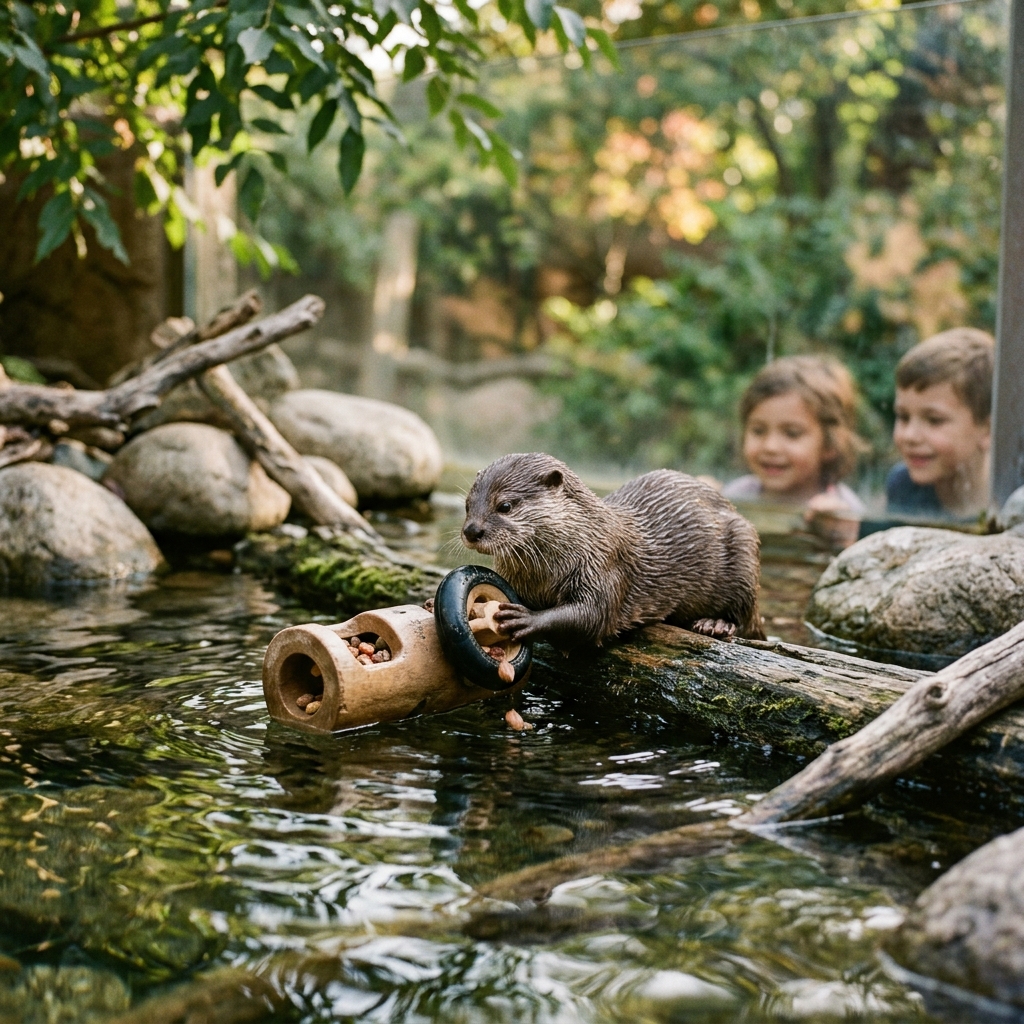
An otter interacting with a floating object may be using its paws, teeth, and teamwork. A bird exploring a hanging item may be using balance and coordination.
Habitat Enrichment
Sometimes enrichment is built into the habitat itself.
Climbing structures, pools, rocks, logs, shade, tunnels, perches, digging areas, and different textures can all give animals choices in how they move and spend their day.
A red panda climbing high above the ground, a goat balancing on a structure, a primate moving through ropes, or a tiger exploring its habitat can all remind families that a good zoo habitat is not just about space. It is also about meaningful use of that space.
Social Enrichment
Some animals are social by nature. Others prefer more independence. For social species, enrichment may include carefully managed group interactions, opportunities to communicate, or activities that encourage natural social behavior.
Watching animals interact can be fascinating. Birds may vocalize or gather near a feeder. Meerkats may take turns watching their surroundings. Sea lions may move together in the water. Arctic foxes may chase, pause, and pounce in ways that make visitors stop and smile.
These moments are fun, but they also remind us that animal behavior can be layered and complex.
Training Is Not Just for Shows
One of the most misunderstood parts of zoo care is training.
When some people hear “animal training,” they may picture tricks or performances. But in modern zoos, training is often an important part of animal care.
Many zoos use positive reinforcement training, which means animals are rewarded for voluntarily participating in certain behaviors. This can help animals take part in their own health care.
For example, an animal may learn to:
Step onto a scale Present a paw, hoof, wing, or flipper Open its mouth Hold still for a quick check Move calmly from one area to another Allow keepers to look at teeth, feet, feathers, or skin Participate in voluntary medical care
This kind of training can reduce stress because the animal has a choice and understands the routine. It can also make care safer for both the animals and the staff.
So if you see a keeper working with an animal, do not assume it is only entertainment. It may be a behind-the-scenes care routine happening right in front of you.
That is one of the best parts of visiting the zoo. Sometimes the most educational moments are not loud or flashy. They are quiet, patient, and built on trust.
Become a Zoo Detective: What Families Can Look for
One of the easiest ways to make a zoo visit more educational is to turn your family into zoo detectives.
Instead of only asking, “Where is the animal?” try asking, “What is the animal doing?”
That one question changes everything.
Here are some family-friendly questions to ask during your next zoo visit:
What is the animal using?
Look closely. Is the animal using its paws, beak, trunk, claws, nose, tail, wings, flippers, or whole body?
A bird using its beak to explore a feeder is different from a bear using its paws to move an object. A sea lion using its body to turn quickly underwater is different from a fox using its nose to follow a scent.
What sense is the animal using?
Is the animal smelling, listening, watching, touching, tasting, or searching?
A big cat investigating a scent trail is using smell. A meerkat standing alert may be watching its surroundings. A bird calling to another bird may be communicating.
Does this remind us of something it might do in the wild?
This is a great question for kids.
A foraging animal may be searching for food. A climbing animal may be using balance and strength. A swimming animal may be using muscles and movement. A digging animal may be using instincts connected to shelter, food, or exploration.
Is the animal solving a problem?
Puzzle feeders, hidden food, floating toys, and new objects can all encourage problem-solving.
Ask: What is the challenge? What is the animal trying to figure out? Did it try more than one method?
Is the animal choosing what to do?
Choice is an important part of animal welfare. Sometimes animals choose to play. Sometimes they choose to rest. Sometimes they choose to move away from visitors. Sometimes they choose shade, water, height, or quiet.
That is a good reminder for families: a resting animal is not a boring animal. Rest is part of life, too.
A Simple Zoo Detective Activity for Kids
Here is a fun activity families can try during a zoo visit.
Give each child a notebook or use the notes app on your phone. Then ask them to find examples of animals doing the following:
An animal using water An animal climbing An animal sniffing something An animal searching for food An animal playing with an object An animal interacting with another animal An animal resting in a favorite spot An animal using its paws, beak, trunk, or tail An animal watching its surroundings An animal solving a problem
At the end of the visit, ask everyone to share their favorite “zoo detective” moment.
This turns a regular zoo day into a learning adventure without making it feel like homework. Kids get to observe. Adults get to slow down. Everyone gets to notice more.
And honestly, that is one of our favorite things about visiting zoos. The more you look, the more you see.
What Animal Play Can Teach Us About Ethical Zoos
Animal enrichment also connects to a bigger topic: ethical zoo care.
A well-managed zoo is not only focused on displaying animals. It is also focused on animal welfare, conservation, education, veterinary care, habitat design, and meaningful daily care.
Enrichment is one sign that a zoo is thinking about the animal’s life, not just the visitor’s view.
That does not mean visitors will see enrichment every minute of every visit. Animals have routines. They rest. They move behind the scenes. They may be more active at certain times of the day. Weather, age, personality, species, and individual preference all matter.
But when you do see enrichment, it can help you appreciate how much thought goes into animal care.
Instead of walking past and saying, “That animal is just playing,” you might say:
“That animal is exploring.” “That animal is problem-solving.” “That animal is using its senses.” “That animal is moving in a natural way.” “That animal is participating in its own care.”
That kind of observation helps families become more thoughtful zoo visitors.
The Fun Science Behind the Smile
At Zoos4You, we believe zoo visits should be fun. They should make you smile. They should give families something to talk about on the ride home.
But fun and learning do not have to be separate.
A polar bear splashing in the water can be fun and educational. A fox pouncing on an object can be cute and meaningful. A sea lion chasing a toy can be entertaining and connected to movement. A bird working at a feeder can be beautiful and behavior-rich. A keeper training session can be simple to watch and deeply important behind the scenes.
That is why animal enrichment is such a great topic for families. It lets kids enjoy the moment while adults understand the care behind it. It helps visitors move from “Look at that!” to “I wonder why it is doing that?”
That little bit of curiosity can change the whole visit.
Final Roar: Slow Down and Watch Closely
The next time you visit a zoo, try not to rush from one habitat to the next.
Pause for a few extra minutes. Watch what the animal is doing. Look for movement, curiosity, play, rest, problem-solving, and choice. Read the signs. Ask keeper questions when staff are available. Let kids make guesses. Let adults learn something new, too.
Zoo animals are not just there to be seen. They are living, thinking, sensing, moving creatures with behaviors worth noticing.
And sometimes, the funniest zoo moment of the day may also be the most educational.
So slow down. Watch closely. Ask questions. Smile often.
That is the Zoos4You way: explore more, learn more, and enjoy the wild little moments that make every zoo visit unforgettable.
Sources
“Animal Enrichment.” Smithsonian’s National Zoo and Conservation Biology Institute, Smithsonian Institution, nationalzoo.si.edu/animals/animal-enrichment
“Animals in Action.” San Diego Zoo Wildlife Alliance Story Hub, 7 Apr. 2020, sandiegozoowildlifealliance.org/story-hub/2020/04/07/animals-in-action
“Cheetah.” San Diego Zoo, San Diego Zoo Wildlife Alliance, zoo.sandiegozoo.org/animals/cheetah
“Cheetah.” San Diego Zoo Wildlife Alliance Science, San Diego Zoo Wildlife Alliance, science.sandiegozoo.org/species/cheetah
“Himalayan Highlands.” Bronx Zoo, Wildlife Conservation Society, bronxzoo.com/things-to-do/exhibits/himalayan-highlands
“Polar Bear.” San Diego Zoo, San Diego Zoo Wildlife Alliance, zoo.sandiegozoo.org/animals/polar-bear
“Polar Bear Plunge.” San Diego Zoo, San Diego Zoo Wildlife Alliance, zoo.sandiegozoo.org/places/polar-bear-plunge
“Elephant Odyssey.” San Diego Zoo, San Diego Zoo Wildlife Alliance, zoo.sandiegozoo.org/places/elephant-odyssey
“Asian Small-Clawed Otter.” Denver Zoo Conservation Alliance, denverzoo.org/animals/asian-small-clawed-otter
Miller, Lance J. “Visitor Reaction to Pacing Behavior: Influence on the Perception of Animal Care and Interest in Supporting Zoological Institutions.” Zoo Biology, vol. 31, no. 2, Mar. 2012, pp. 242–248. PubMed, pubmed.ncbi.nlm.nih.gov/21773984
“Study on Activity Pattern and Incidence of Stereotypic Behavior in Captive Tigers.” Faunalytics, 13 Mar. 2015, faunalytics.org/study-on-activity-pattern-and-incidence-of-stereotypic-behavior-in-captive-tigers